One of the most common questions from Bekasi buyers is: "How much are dates per kg right now?" There is no single answer, because price depends on variety, grade, packaging, season, and whether you buy retail or wholesale. This article presents a Bekasi date price list for 2026 compiled from several open sources (Tempo.co, Blibli, Tokopedia, and Media Indonesia) as a reference, not a fixed quote. The goal is to help residents of Kota and Kabupaten Bekasi compare fairly before ordering.
Bekasi Date Price Table 2026 (Retail vs Wholesale)
The ranges below reflect early-2026 market prices for common grades. Retail is the 500 g-1 kg pack; wholesale is per 5-10 kg carton. Always confirm current prices via WhatsApp because exchange rates and seasonality move the numbers.
| Variety | Retail / kg | Wholesale / kg | Notes |
|---|---|---|---|
| Egyptian (Golden Valley) | Rp45,000 - Rp70,000 | Rp35,000 - Rp55,000 | Cheapest, ideal for mass takjil |
| Khalas (UAE) | Rp60,000 - Rp85,000 | Rp50,000 - Rp65,000 | Soft, widely used by mosques |
| Tunisia / Deglet Noor | Rp65,000 - Rp95,000 | Rp55,000 - Rp75,000 | The Queen, semi-dry |
| Sukari | Rp70,000 - Rp140,000 | Rp55,000 - Rp95,000 | Honey date, family favourite |
| Mazafati (Bam Rutab) | Rp75,000 - Rp120,000 | Rp60,000 - Rp90,000 | Wet, needs cold-pack |
| Safawi | Rp95,000 - Rp160,000 | Rp80,000 - Rp140,000 | Madinah black, soft |
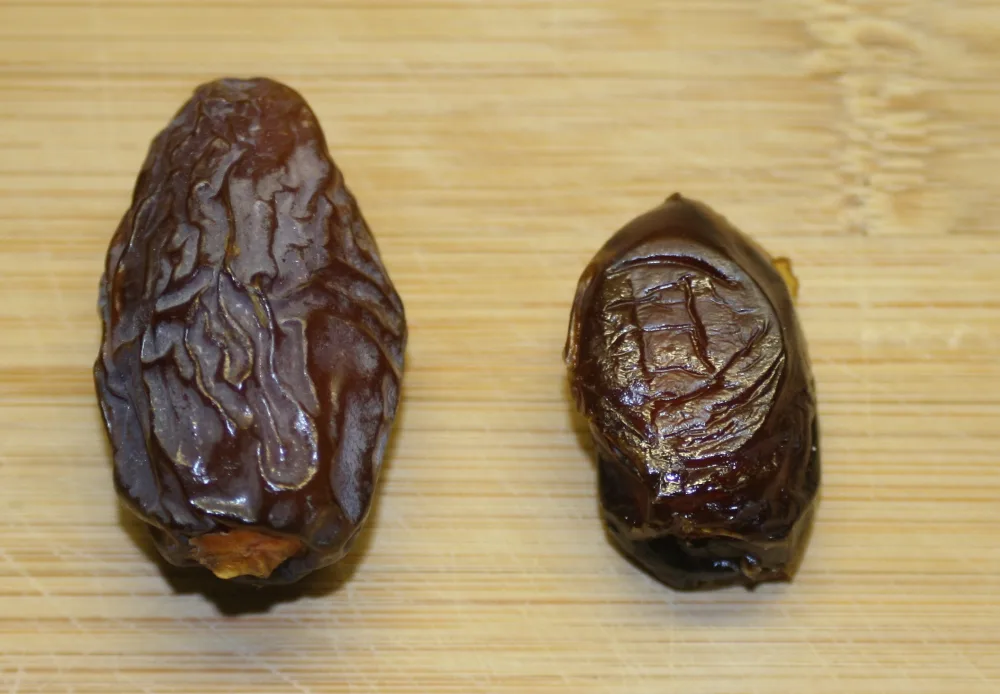
| Medjool | Rp180,000 - Rp320,000 | Rp150,000 - Rp280,000 | King of Dates, jumbo fruit |
| Ajwa | Rp200,000 - Rp400,000 | Rp180,000 - Rp350,000 | Religious premium, by grade |
Why Do Date Prices Vary So Much?
Understanding price drivers makes you more confident when negotiating. Here are the main factors.
1. Variety and Origin
Ajwa and Safawi come exclusively from Madinah, Saudi Arabia; Medjool from Palestine, Jordan, and Morocco; Mazafati from Bam, Iran; while Egyptian and Tunisian dates are mass-produced and therefore cheaper. Per BPS and Goodstats data, Egypt supplies 56-62% of Indonesia's dates, which explains why Egyptian dates are the most affordable.
2. Grade and Size
For the same variety, a Super Jumbo fruit can cost twice a small one. When you see an ad for "Ajwa Rp180,000", ask the grade — it is almost certainly a small grade, not Jumbo.
3. The Ramadan Season
CNBC Indonesia and Kompas report that date prices at markets such as Tanah Abang jump before Ramadan as demand rises sharply. BPS records peak imports in the five months before Ramadan and Eid al-Fitr. Ramadan 2026 began 19 February 2026 (Detik), making January-March the highest-price window.
4. Condition (Wet vs Dry)
Wet dates such as Mazafati and Rutab need a cold chain, so their storage cost raises the price compared with longer-lasting dry dates.
Smart Date-Buying Tips in Bekasi
- Buy before Ramadan: order in December-January before prices spike.
- Choose the grade you need: for mass takjil, grade A is enough; save VIP grade for gifts.
- Move to wholesale for volume: if you need over 5 kg, the per-kg price drops significantly.
- Compare apples to apples: match variety and grade before comparing prices across sellers.
- Consider a direct importer: cutting the middleman means a fairer price for the same grade.
What Is a Realistic Budget?
For a family stocking up for Ramadan, a budget of Rp150,000-Rp300,000 is enough for 2-3 kg mixing Sukari, Tunisia, and a little Ajwa. For premium hampers, set aside Rp350,000-Rp750,000 per pack containing 4-6 varieties. For resellers, an initial outlay of one carton of Sukari plus one carton of Egyptian dates can start under Rp1 million. Also study our Lebaran hamper guide and date-storage guide so your spending is not wasted.
Reading Date Price Ads Without Getting Fooled
In Bekasi, on both marketplaces and social media, ads often appear with prices that look too cheap for a premium variety. Several things deserve scrutiny to avoid misunderstanding. First, check the unit: a price of "Rp50,000" may be for a 250 g pack, not 1 kg — meaning the real per-kg price is Rp200,000. Second, check the grade: very cheap Ajwa or Safawi is almost certainly a small grade or a blend, not whole Jumbo fruit. Third, beware confusing trade terms; for example, "Golden Valley" is a brand/variety of Egyptian dates, not a premium class despite the luxurious name. Fourth, "wet" and "dry" prices for varieties like Sukari can differ because of moisture content. By reading these details, Bekasi residents avoid the disappointment of receiving a product that does not match expectations.
Per-Piece Price Estimates for Planning
Beyond the per-kg price, knowing the rough per-piece price helps planning, especially for hampers and takjil. The pieces per kg depend on variety and grade: small dates around 90-120 pieces/kg, medium 60-90 pieces/kg, and jumbo 40-60 pieces/kg. As an illustration, large-grade Ajwa at Rp350,000/kg with ~50 pieces means about Rp7,000 per piece; while Egyptian dates at Rp60,000/kg with ~110 pieces is only about Rp545 per piece. This simple calculation is very useful when budgeting a gift or counting iftar portions for an event.
Price Trends: Why Monitoring Matters
Date prices in Bekasi are not static year-round. There is a predictable seasonal pattern: prices are relatively stable and tend to be lower in the second half of the year (outside Hajj season), begin creeping up a few months before Ramadan, peak just before and during the early fast, then gradually normalise after Lebaran. Understanding this pattern offers a real advantage: smart buyers and resellers stock up when prices are low, then hold stock to sell or consume when demand is high. This is why we maintain a periodically updated price reference — so Bekasi residents have an objective benchmark rather than mere guesswork. For certain limited-supply varieties such as wet Mazafati or Jumbo-grade Ajwa, fluctuations can be sharper because availability depends on the harvest season in the country of origin.
Important Note
This price list is educational and indicative; real prices change daily with supply, the rupiah exchange rate, and season. We refresh this reference periodically and always confirm final pricing directly based on current stock. By understanding price drivers and the grade system, Bekasi residents can shop for dates wisely — not falling for a "cheap" price that turns out to be a low grade, and not overpaying for what is actually standard.